

Prof. B. Mahadevan
Leadership Lessons from Indian Knowledge Systems.
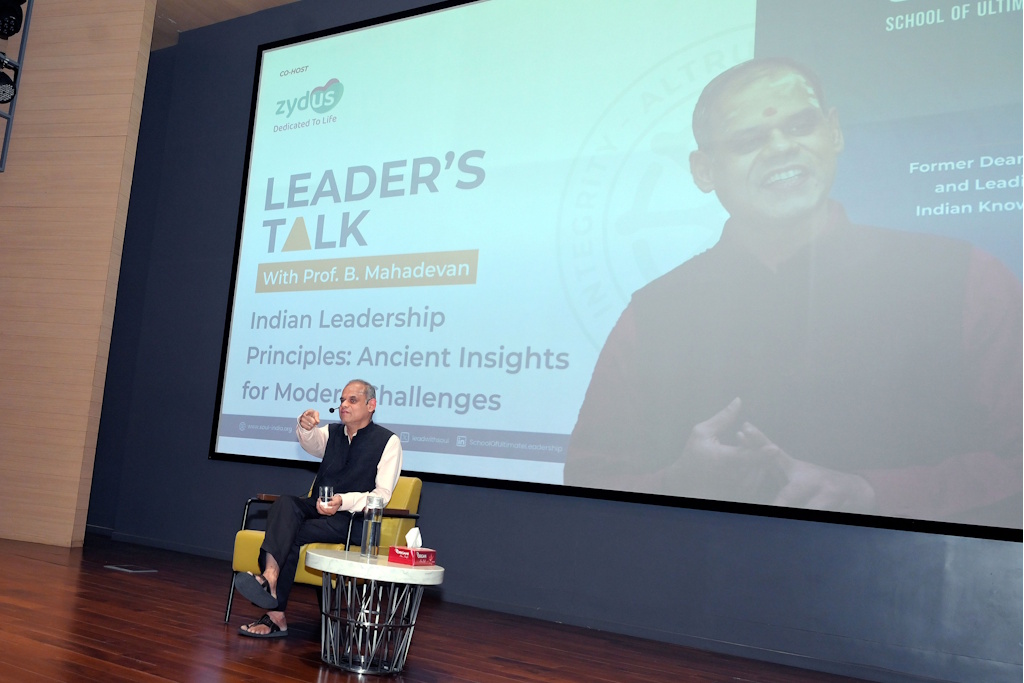
The School of Ultimate Leadership (SOUL), co-hosted by Zydus, held an engaging session in its Leader’s Talk series featuring Prof. B. Mahadevan, former Dean at IIM Bangalore and Founding Vice Chancellor of Chinmaya Vishwa Vidyapeeth. His talk, “Indian Leadership Principles: Ancient Insights for Modern Challenges,” opened up often-overlooked dimensions of leadership: those of the inner world.
Prof. Mahadevan challenged the dominance of Western frameworks, which tend to focus exclusively on external metrics: vision, execution, performance, and strict controls. What’s often missing is attention to the leader’s self-mastery, humility, resilience, and inner balance. Indian knowledge systems, he argued, provide precisely this missing depth, enabling leaders to become not just effective strategists, but guardians of values and purpose.
He emphasized that leadership failures rarely result from lack of intelligence or skill; they happen when leaders lack inner mastery. Emotional regulation, ego management, and the ability to adapt are what set sustainable leaders apart. “Only a leader anchored in the self,” as Mahadevan put it, “can truly navigate external storms.”
Drawing from the Bhagavad Gita and other Indian texts, he explored the “Principle of Duality”, success and failure, joy and sorrow, praise and blame. The inability to accept life’s dualities with equanimity, he noted, creates fragile leaders. Wisdom in leadership, then, rests on understanding impermanence.
Among the most striking ideas was his discussion of the “Art of Dying.” Going beyond metaphors about letting go of ego, Prof. Mahadevan spoke about the conscious acceptance of mortality as the ultimate leadership practice. Leaders who reflect on death, he suggested, shed their illusions of permanence, gain clarity, and make decisions grounded in humility and realism. This is not about renunciation, but about leadership rooted in perspective.
He connected the principle of selfless action “Nishkama Karma” from the Bhagavad Gita with the idea that genuine leadership arises when one moves beyond asking, “What’s in it for me?” Such leaders inspire by example.
Prof. Mahadevan distinguished “brainstorming” from “brain-stilling,” arguing that a calm, clear mind trumps the restless pursuit of ideas. “People follow energy before they follow strategy,” he remarked—highlighting presence as vital to inspiration. True leadership is less about authority or charisma, more about inner strength, authenticity, and trust.
The event drew a wide spectrum of participants, from students to senior professionals, all seeking fresh perspectives. The session closed with a lively Q&A and a networking lunch hosted by Zydus, offering attendees the rare opportunity for informal interaction with Prof. Mahadevan. These exchanges enriched the experience further
This session was more than an intellectual exercise; it was a call to action. It reminded everyone present that the future of leadership will not be defined solely by technological prowess or market intelligence, but by the inner strength, humility, and balance of those who lead.
The Leader’s Talk series continues to serve as a platform for exploring new dimensions of leadership, to nurture leaders who combine competence with consciousness, ambition with ethics, and influence with inner stillness. By hosting voices like Prof. Mahadevan, SOUL reaffirms its commitment to shaping leaders who can not only build organisations but also elevate society.